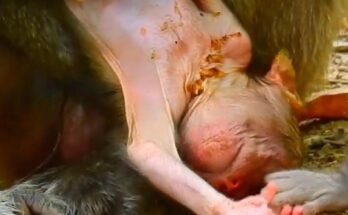
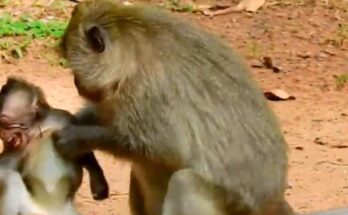
The little baby monkey looked completely exhausted after spending so much energy trying to keep up with his mother. His tiny body was weak, and every movement became slower as he struggled across the rough ground. When his mother finally released him and continued moving away, the helpless infant was left sitting alone with no idea what to do next.
Within moments, the baby began screaming as loudly as he could. His heartbreaking cries echoed through the area, hoping his mother would hear and return. He stretched out his tiny arms, looking in every direction for the familiar face that had always made him feel safe. Every cry seemed filled with fear, confusion, and desperation.
The little monkey tried to crawl after his mother, but he was simply too tired. His legs trembled beneath him, and he collapsed back onto the ground, crying even harder. Dust covered his soft fur as tears filled his eyes. To the tiny infant, every second without his mother’s comfort felt frightening and lonely.
Although this emotional scene appears heartbreaking, young monkeys often become distressed when separated from their mothers, even for a short time. Baby monkeys depend heavily on their mothers for warmth, protection, transportation, and reassurance while they learn how to survive in their challenging environment. Temporary separation can trigger loud cries as the infant attempts to regain contact.
The baby’s loud screams showed just how deeply he depended on his mother. Every sound carried a message of longing, asking her not to leave him behind. His small body shook as he continued calling, refusing to give up hope that she would return.
Eventually, the little monkey remained on the ground, exhausted from crying. His breathing slowed as he waited quietly, still watching the direction his mother had gone. Whether she returned moments later or encouraged him to follow on his own, the emotional bond between mother and baby remained clear.
This touching moment reminds us how vulnerable young animals are during the earliest stages of life. Their cries reflect their instinct to stay close to the one who protects and nurtures them. For viewers, it is a powerful reminder of the importance of compassion and respect for wildlife, allowing these remarkable animals to grow and thrive naturally in their own environment.